
Where the ashtrees dream
A cycle of stories about longing, trials and true power
Longing, trials and the shape of power
Where the Ash Trees Dream is a cycle of interconnected prose and a contemporary stage play.
Mythic imagery and grounded dialogue move alongside one another, tracing the same questions from different angles.
What appears symbolic on the surface reflects emotional and psychological realities beneath it.
The work unfolds as an initiation. It begins with recognition - the moment perception shifts.
It moves through trials - where illusion fractures and loss leaves its mark.
And it arrives at power - not as control or escape, but as the ability to remain present and choose consciously.
Love runs through everything. Often romantic in form, but never only that.
It appears as longing, projection, devotion, and illusion.
Beneath it lies a quieter question: how to love deeply without disappearing in the process.
The texts are meant to be read in the proposed order. Together they form a map.
Each story reveals another layer of the same inner landscape.
Chapter I - Recognition
Recognition is not discovery. It is remembering.
This chapter marks the first shift in perception. Familiar structures begin to crack.
Inheritance becomes visible. Longing steps forward without disguise.
Archetypal figures appear - not as fantasy, but as mirrors of what was already moving beneath the surface.
Here, nothing is resolved. But everything is seen.

Cassandra

Antevasin

Twilight of the Gods

A tale of water
Chapter II - Trials
Once something has been seen, it cannot be unseen.
This chapter moves through loss, betrayal, grief, and disillusionment.
Love is tested. Illusion collapses.
The self confronts the cost of attachment and projection.
What felt eternal reveals its fragility.
The trials are not punishment. They are refinement.
What survives them is no longer imagined - it is lived.
*Trigger Note: this chapter contains themes of stillbirth, suicide, emotional manipulation, and grief.

The Gods laugh

Paradise in Hell

The Raven
Chapter III - Power
Power does not arrive with spectacle. It emerges quietly after illusion has burned away and grief has settled.
In this chapter, inheritance is faced without repetition. Longing changes direction.
The threshold appears once more, but the choice is different.
What once tempted escape now asks for presence.
Power here is alignment. The courage to remain.
The ability to love without disappearing in the process.

The silver-haired child

Where the ashtrees dream

Becoming

The Garden beyond the veil
OBSIDIAN - THE CODA
A coda is a deliberate closing movement.
In music, it gathers themes that have
already appeared and allows them to
resolve in concentrated form.
It does not expand the narrative;
it distills it.
Within this cycle, the coda functions
as compression. The questions of longing,
illusion, and power are no longer explored
through multiple figures or stages.
They converge in a single encounter.
The symbolic language remains,
but it is no longer searching.
It knows.
The coda clarifies what “power” has come to mean.
Obsidian brings the theme of power into direct relation.
After recognition and trial,
after projection and disillusionment,
power appears not as conquest
or transcendence, but as sovereignty.
Two presences meet without possession.
No one is saved. No one is consumed.
What unfolds is not control or domination
in the conventional sense, but a mutual recognition
of strength and surrender.
The imagery of obsidian -
volcanic glass, formed under pressure -
mirrors this: sharp, reflective, born of fire.
The story closes the cycle by
redefining power as the ability
to remain intact while entering intensity.
Not to overpower. Not to disappear.
But to stand, and to choose.

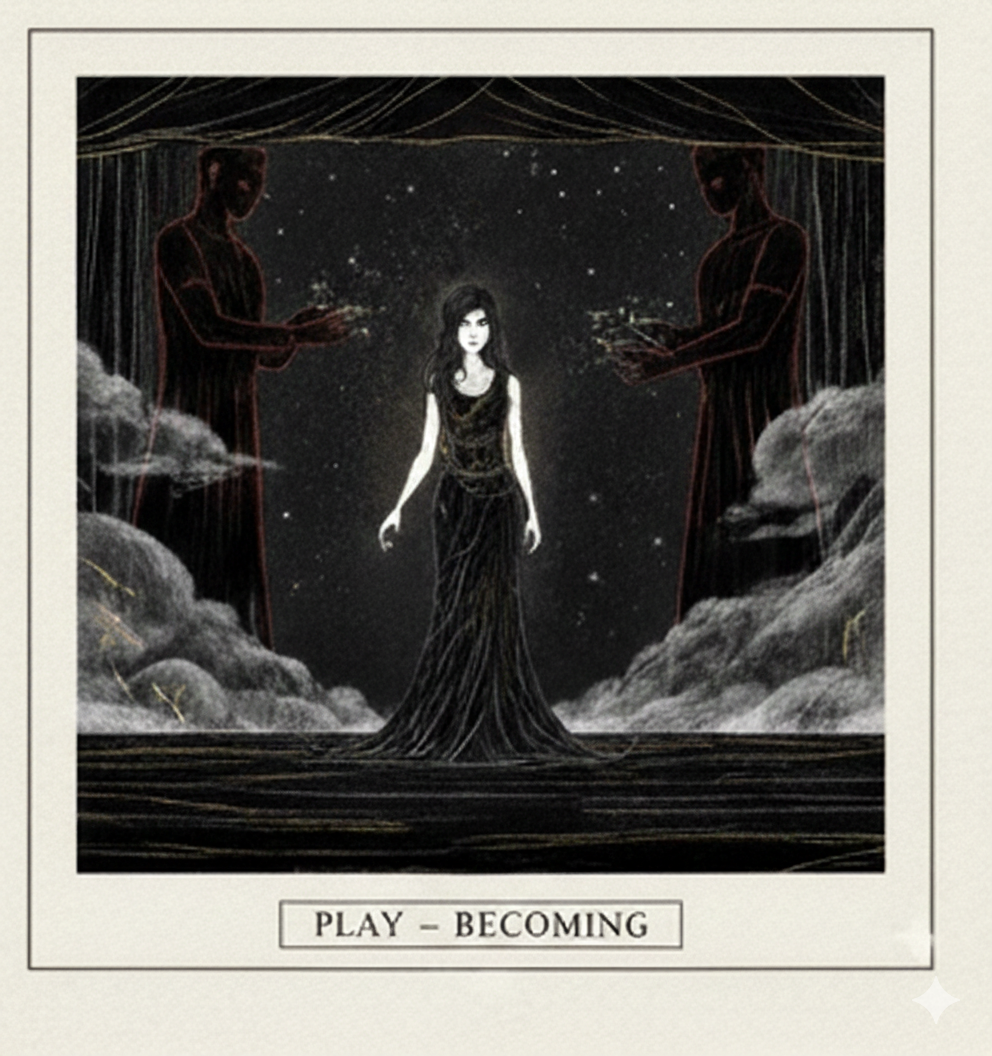
BECOMING - THE PLAY
The play continues the movement of the cycle in spoken form. What is explored symbolically in the prose takes shape here in conversation, confrontation, and decision. In a contemporary setting, longing and power are no longer internal reflections but lived tensions.
What was once myth becomes presence.